Supplementary material: Learning from claims related to early onset Group B Streptococcal disease in neonates
This material is designed to supplement the reader’s understanding of and response to NHS Resolution’s Learning from claims related to early onset Group B Streptococcal disease in neonates.
Group B Streptococcus (GBS) is the leading cause of serious bacterial infection in the first few weeks of life and is a major global cause of neonatal meningitis, sepsis and pneumonia. It is estimated to be responsible for around 91,000 infant deaths and 46,000 stillbirths globally per year1. It is also a significant cause of ongoing morbidity (severe disability at follow-up) in up to 26% of those with meningitis2-3 and up to 9% of those with sepsis3-4.
GBS is present in the bowel flora of 20-40% of adults, varying slightly among different racial groups1. GBS colonisation is usually asymptomatic and does not pose a risk to the carrier. There is no evidence that the physiological state of pregnancy affects the colonisation rate of adult women. However, in those who are colonised with GBS, there is a risk of vertical transmission in the intrapartum period. Around 1-2% of infants born to GBS colonised mothers will develop septicaemia, pneumonia, meningitis or will sadly die 4-5. Preterm and low birth weight babies are at greatest risk of adverse outcomes4.
Prophylactic intrapartum antibiotics (antibiotics during labour) are currently the most effective way to inhibit vertical transmission in mothers known to be carriers of GBS.
Some healthcare systems routinely test all pregnant women close to the expected delivery date. In the UK, testing (or empirical treatment) is only recommended in those with risk factors. Below are the risk factors as set out by the Royal College of Obstetricians and Gynaecologists1.
| Risk factors for having a baby affected by early onset Group B Streptococcal disease |
|---|
| • Previous baby with invasive GBS disease • Incidental finding of GBS carriage during pregnancy (e.g. During testing for a urine infection or a swab for vaginal discharge) • Preterm labour • Prolonged rupture of membranes • Maternal sepsis – Any sign of maternal infection, often resulting in antimicrobial treatment – Maternal pyrexia |
There are two distinct presentations of GBS disease in infants: Early onset GBS (EOGBS), seen in the first week of life, and Late-onset GBS (LOGBS) seen in infants between one week and three months of age. This document exclusively concerns EOGBS disease, in order to focus on the factors that can be modified in perinatal care by obstetric, midwifery and neonatal teams. Late-onset GBS remains an important cause of morbidity and mortality. While it is not explored in this report, parental education about the ongoing risk was highlighted by stakeholders as an area of importance. More information can be found in the links at the end of the resource.
Like many infections in neonates, GBS has a non-specific presentation. The NICE guidance on neonatal sepsis outlines clinical indicators of sepsis in the newborn6.
| Signs of neonatal sepsis, as outlined in NICE guidance6 |
|---|
| Red flag clinical indicators • Apnoea (temporary stopping of breathing) • Seizures • Need for cardiopulmonary resuscitation • Need for mechanical ventilation • Signs of shock |
| Other clinical indicators • Altered behaviour or responsiveness • Altered muscle tone (e.g. floppiness) • Feeding difficulties (e.g. feed refusal) • Feed intolerance, including vomiting, excessive gastric aspirates and abdominal distension • Abnormal heart rate (bradycardia or tachycardia) • Signs of respiratory distress (including grunting, recession, tachypnoea) • Hypoxia (e.g. central cyanosis or reduced oxygen saturation level) • Persistent pulmonary hypertension of newborns • Jaundice within 24 hours of birth • Signs of neonatal encephalopathy • Temperature abnormality (lower than 36°C or higher than 38°C) unexplained by environmental factors • Unexplained excessive bleeding, thrombocytopenia, or abnormal coagulation • Altered glucose homeostasis (hypoglycaemia or hyperglycaemia) • Metabolic acidosis (base deficit of 10 mmol/litre or greater) |
Serious infection is more likely in babies born to mothers with low levels of antibodies7-8, hence vaccination may be an option in the future. One problem with a vaccination approach, however, is that there are multiple serotypes of GBS, which shift over time and between populations.
Current research into GBS management includes the GBS3 trial9, looking to ascertain the best approach to testing (routine testing in late pregnancy or at the onset of labour, compared to the current approach of no routine testing), and the iGBS3 programme10, conducting research into vaccine development.
NHS Resolution holds information on all NHS claims in England. By examining claims related to early onset GBS disease we can share data and insights into maternity and neonatal outcomes, aligning with our strategic priorities. We will draw on our unique expertise and work with our system partners to support maternity and neonatal safety improvements.
This data is limited to cases of EOGBS disease which have resulted in a claim. It is not representative of all occurrences of EOGBS disease in the population. It should also be noted that GBS sepsis and disease did not have a dedicated injury code in the NHS Resolution database at the time of the majority of these claims being initiated. Therefore, manual searching of a large number of neonatal cases was required to identify the cases. A specific injury code has since been introduced, making future reviews of the topic more accurate.
In addition, more detailed demographic data such as ethnicity and social deprivation is not included in this dataset, meaning that conclusions regarding the impact of these cannot be drawn from this report.
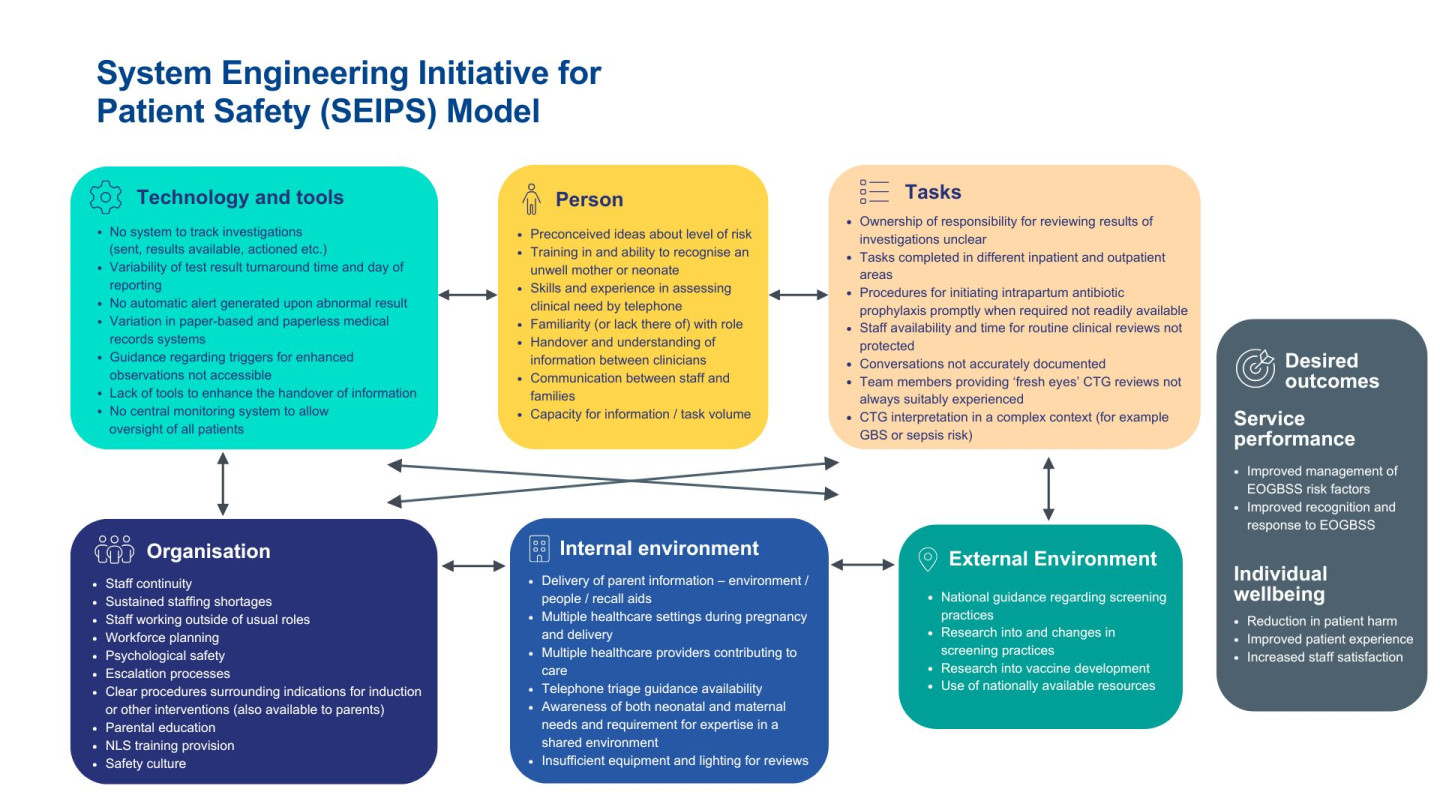
The factors contributing to claims outlined in this leaflet are explored in the following graphics using the SEIPS model. We consider what the contributors were as well as why they came about.
Originally created in 2006, and advocated by NHS England, SEIPS11 is a framework for understanding outcomes within complex socio-technical systems. It allows us to consider how the six elements of the work system, as seen in this cohort, impact directly and indirectly upon outcomes.
The population
This data has limitations with regards to the fact that it is only possible to review closed claims. This means that there will be some claims from the same time period as those included in this analysis that remain open at the time of review. The number of claims identified suggests that, while EOGBS is an important cause of morbidity, the rate of claims for clinical negligence is well below the incidence rate of EOGBS disease. In this claims cohort, 95% were term and 63% required intensive care; these proportions appear higher than typically reported in population incidence studies, but like‑for‑like comparison is limited by data and case mix
However, it is important that these findings, where appropriate, are applied to the wider population, as outlined in the SEIPS analysis.
The costs
When any claim is brought, there is an emotional and personal cost to the families and staff involved, as well as having a financial impact.
Also worthy of note, are the claims where no admissions were made. Some claims may be initiated due to families not fully understanding what constitutes clinical negligence or not having a full understanding of the circumstances and how they have occurred, or if the care provided was appropriate. By prioritising good communication and clear, accurate explanations, it may be possible to improve these experiences.
Family implications
In this cohort, additional inpatient days were required in NICU, PICU, general paediatrics and on the postnatal wards. This additional inpatient time could have deleterious effect on family bonding, including establishing breast feeding. It is known that parents of babies who have spent time in neonatal care are at risk of developing post-traumatic stress disorder as well as postnatal depression12.
Financial implications
There may be a financial impact on parents by way of childcare costs or missed employment. There is also a financial impact on the trusts to provide these additional care days. Optimising practice around GBS care may allow us to prevent or reduce some of these hospital stays.
Published: