Advice for clinicians on responding to clinical negligence claims
Working on the frontline in the NHS can be challenging, especially if, as a clinician, you are involved in an incident that may lead to a complaint or a clinical negligence claim.
We have collated a list of resources to guide clinicians through the process of resolving any claims for compensation against the NHS that they may find themselves involved with.
This page aims to:
- explain the reasons why people make a complaint or a claim;
- outline what happens after an incident occurs;
- highlight the importance of saying sorry in a timely and meaningful way;
- help clinicians understand the claims process and when and why their involvement is needed; and
- signpost to other sources of support for those involved in an incident where harm has occurred.
1. What happens after an incident occurs
There are a number of things which may happen after an incident, some of which may run concurrently:
- Inquest if the incident involves a death
- Patient Safety Incident Response Framework (PSIRF)
- Complaint: internal or with Parliamentary and Health Service Ombudsman (PHSO) can happen any point
- Claim
- Disciplinary process: undertaken locally or by the relevant regulatory body
The resources contained in this webpage will help if you have been involved in any of the processes above. And if you need further information and support, please reach out to your legal team.
2. Support for clinicians
After an incident occurs, the processes which follow can be extremely stressful and confusing for the clinicians involved. There may be overlap between the investigation, complaint, claims and any regulatory processes albeit with potentially different outcomes.
Below are a set of scenarios with links to some information and organisations that can provide clarity and support through these various processes. Please note that this is not an exhaustive list and we would encourage you to explore further avenues that you may find helpful.
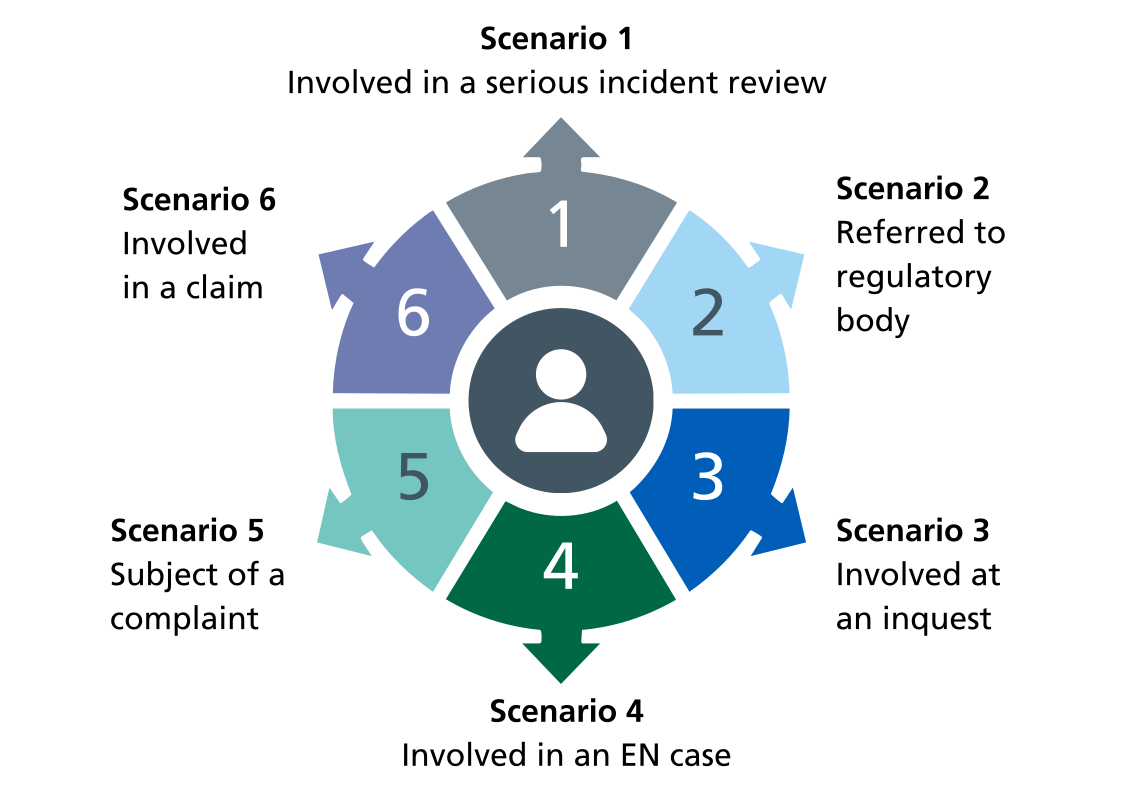
Useful resources
3. Motivation to claim
There are a variety of reasons why people claim for compensation. Claims may be brought after something has gone wrong in a patient’s healthcare or when the care and treatment they received did not meet the expected standards. Understanding why people are bringing claims for compensation can help highlight systems and processes that can be improved to:
- Prevent and resolve concerns outside the claims process.
- Assist healthcare providers in improving the patient experience and identify and resolve potential risks to patient safety.
In 2018, in partnership with The Behavioural Insights Team (BIT), NHS Resolution undertook research to consider the experience reported by over 700 patients.
The research found that the motivation to pursue a claim broadly came from:
- Wanting to receive an adequate and appropriate apology for something that had gone wrong
- Wanting an understandable explanation for an incident, or to trigger a detailed investigation of the incident
- The quality of communication (both verbal and written) experienced in the complaints stage and feeling that a meaningful outcome had not been achieved
- Financial compensation
Useful resources
4. Compassionate claims handling
Duty of candour animation
An 8-minute animation offering guidance to help those working in health and social care to understand the similarities and differences that exist between the professional and statutory duties of candour.
Useful resources:
UK Government guidance on Duty of Candour
NHS Resolution virtual forum on duty of Candour
NHS Resolution roll out of compassionate conversations workshops
Duty of candour
Healthcare professionals have a professional duty of candour, which requires open and honest communication with patients when something goes wrong with their treatment or care that causes harm or distress, or has the potential to do so.
Health and social care providers also have a statutory duty of candour, which requires them to act in an open and transparent way in relation to the care provided to patients.
The duty of candour requires you to tell a patient when something has gone wrong, to make a meaningful apology and to explain the possible short and long-term effects of what has happened.
Our animation aims to help those working in health and social care to understand the similarities and differences that exist between the professional and statutory duties of candour.
5. Saying Sorry
Good, timely communication with patients and families is vital when responding to incidents, complaints and claims. This should be personalised to the patient.
The information shared with the patient or their family and a meaningful apology may need to be repeated if the patient or family are in shock or grief.
Where harm has happened – absent, delayed or poor explanations to patients or staff make it more likely that the injured party will seek the information in a different way. This could be by making a complaint or taking legal action.
The lack of a meaningful apology increases the likelihood of a claim.
Saying sorry is:
- not an admission of liability
- always the right thing to do
- the first step to learning from what happened and preventing it recurring, by acknowledging that something could have gone better
“We have never, and will never, refuse cover on a claim because an apology has been given.”
Alan’s story video
Alan’s illustrative case story set out in this video emphasises the importance of supporting patients and their families following an incident, and the importance of saying sorry.
6. Being fair
Perception of there being a lack of empathy when concerns are raised is a significant driver for claims.
Taking an empathetic approach can reduce stress on all those involved with an incident: the patient; their family and the staff involved. It may assist in earlier resolution.
NHS Resolution has produced a number of resources around being fair, aiming to promote the value of a person-centred workplace that is compassionate, safe and fair when care in the NHS goes wrong.
Useful resources
7. Understanding the legal process
Our Clinical Negligence Scheme for Trusts (CNST) indemnity scheme handles all clinical negligence claims against NHS trusts. It is the member organisation (e.g. the trust) who is the legal defendant, rather than the clinician(s) involved in the incident. It is important to note that, where a healthcare professional acts in the course of their employment with the trust, any claim for compensation will be brought against the trust rather than the individual.
We acknowledge that the claims process can be difficult for clinicians and that it is important to have support locally, from NHS Resolution and/or from any solicitors who might be instructed to investigate and respond to the claim on the member’s behalf.
This section outlines the legal process involved with a negligence claim.
The clinical claims journey
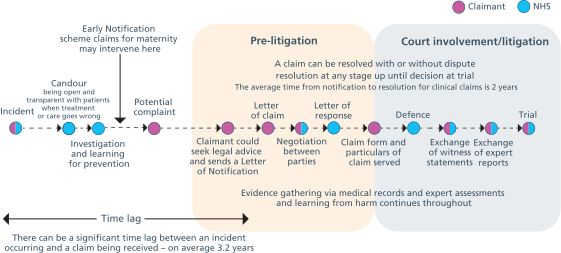
Source: Annual Report and Accounts 2025/26, Page 35
8. What is a claim?
Clinical negligence claims arise when a healthcare professional or an institutional health provider, such as a trust, breaches their duty of care to a patient, who suffers harm as a result of the breach.
A claimant may seek legal advice after experiencing an adverse outcome to medical treatment. However, an unexpected or disappointing outcome does not necessarily mean that the healthcare provider failed to act with reasonable care and skill, or that their acts or omissions caused or materially contributed to the injury complained of.
To establish that there has been a breach of the duty of care, the claimant must show that the healthcare professional has followed a course of action which would not be supported by a reasonable body of medical opinion held by clinicians acting in the same field.
To succeed in a claim for compensation (i.e. for liability to be established) a claimant must show both that the defendant breached its duty of care to the claimant, and that the breach of duty caused or materially contributed to their injury or loss.
Claims are usually brought within three years of the date of the alleged negligence or within three years of the date of knowledge i.e. three years from the date on which a reasonable person would have become aware that a significant injury has been suffered, which may have been caused in whole or in part by the act or omission which is alleged to constitute negligence.
For children, limitation expires three years after their eighteenth birthday (i.e. when they turn 21) or three years after any later date of knowledge.
Where someone lacks capacity within the meaning of the Mental Capacity Act 2005, and this was the case at the date of the alleged negligence and/or the date of knowledge, limitation does not start to run until if/when capacity is (re)gained.
The court does have discretion to extend the limitation time frames, so it is not uncommon to see claims brought outside this period. For those without capacity (including minors) someone, usually a family member, will become a ‘litigation friend’ to bring a claim on their behalf.
For a successful negligence claim, three elements must be proven:
1. The NHS owed a duty of care
2. That duty was breached
3. The breach directly caused harm
9. Overview of the claims process
The claims process can be complex and can sometimes take a long time to resolve. There can be a significant time-lag between an incident occurring and a claim being made – on average three years.
Once a patient or family member decides to make a claim there are several procedural and investigative stages before a decision can be made on liability. It may then also take some time to quantify and agree damages on a claim, particularly on high-value claims such as where brain damage has occurred at birth and where a full assessment cannot be undertaken until the child has reached a certain age.
For information about the legal process in general practice: please see our lifecycle of a clinical negligence claim in general practice infographic and frequently asked questions
Useful resources
Role of case law
The law, especially in the area of clinical negligence, can evolve through judge-made law, also known as case law. If you are interested in case law and cases of note please visit our case of note archives and legal rulings pages.
10. Inquests
As a healthcare professional, you may become involved in giving factual evidence or expert opinion in a range of legal proceedings and settings. One of the forums that healthcare professionals commonly attend to provide factual evidence is the coroner’s court.
It is important to remember that, although claims for compensation can follow or run alongside an inquest, coronial investigations are not part of the claims process. Rather, an inquest is a fact-finding inquiry into the circumstances around a death. It is not intended to be adversarial or to apportion blame.
In many cases, healthcare professionals will be asked to provide a written statement for the coroner. On some occasions, however, professionals are additionally asked to attend coroner’s court to provide oral evidence at inquest.
Attending a coroner’s court to give evidence can be worrying if this is something you have never done before, and as you may be required to talk about what may have been a difficult or upsetting experience. Your organisation’s legal services team, your medical defence organisation and/or any externally instructed solicitors are likely to be able to provide you with support.
Our inquest module contains useful information to help you prepare for giving evidence at inquests. The resources have been produced for a broad range of healthcare staff and clinical specialities.
Useful resources
11. Learning from claims
Our Safety and Learning team combine clinical expertise with the unique lens of NHS Resolution data to support healthcare systems improve their care and safety cultures.
Working at a national, regional and local level, the team brings vital clinical perspective to enhance clinical governance processes and inform regulatory preparedness.
Our Safety and Learning team have produced various materials to support the health service to learn from harm.
Useful resources
- Safety and Learning homepage
- Claims scorecards: help our members better understand the value and volume of claims by specialty and cause
- Thematic reports: analysis of claims in particular specialities over a defined period
- Topic specific learning materials: to support the health service to learn from harm. We work in partnership with other arm’s length bodies (ALB’s), the Royal Colleges, other stakeholders and charities to promote best practice and support collaboration.
12. Useful links
Links to the rules of NHS Resolution’s schemes:
Please provide feedback on our Advice for clinicians on responding to clinical negligence claims webpage form.
Published: