Our role and accountability
NHS Resolution is a special health authority of the Department of Health and Social Care, accountable to the Secretary of State. We administer indemnity schemes for the NHS and support the delivery of safe care through our wider functions, including practitioner performance advice and primary care appeals.
We are committed to high standards of transparency, accountability and effective stewardship of public funds.
Key documents:
How we are governed
NHS Resolution is governed by its Board, which sets the organisation’s strategy, oversees performance, and ensures effective systems of risk management, governance and internal control are in place. The Board is supported by arrangements that provide assurance on risk management, governance and internal control, including audit and risk oversight.
Further information:
Role of the Accounting Officer
The Chief Executive is the Accounting Officer and is accountable to Parliament for the stewardship of public funds and the performance of NHS Resolution. The Accounting Officer is supported by the Board and assurance functions, including internal audit.
Further information:
Board and Committees
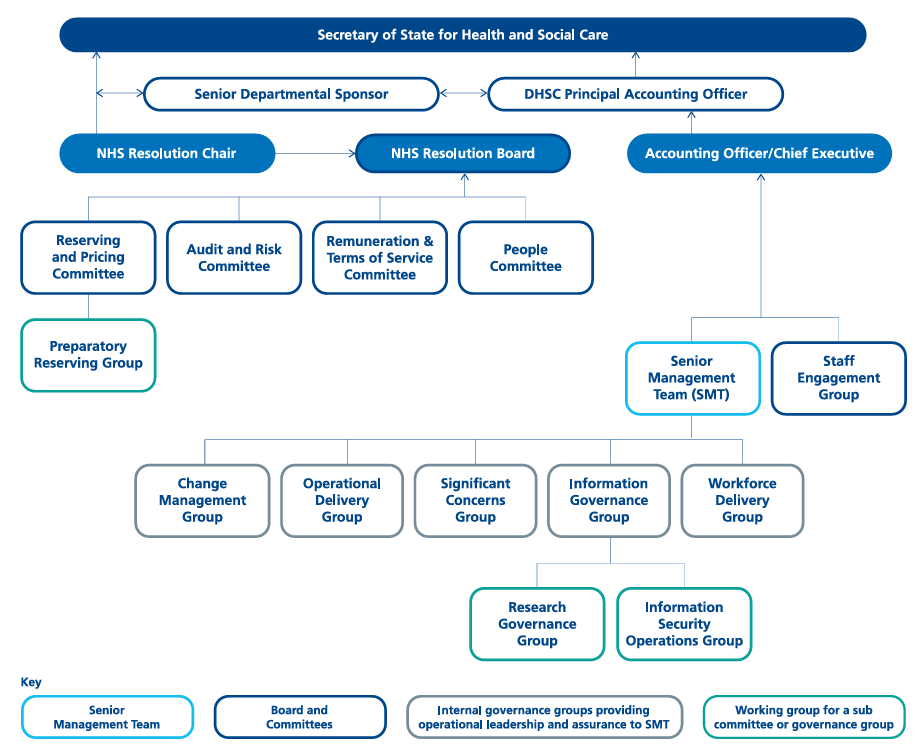
The NHS Resolution Board has four committees to enable it and the Accounting Officer to discharge their responsibilities.
The four committees are:
- Audit and Risk Committee (ARC)
- People Committee (PC)
- Remuneration and Terms of Service Committee (RemCo)
- Reserving and Pricing Committee (RPC)
Each committee is made up of Board members and is chaired by a Non-Executive Director. Independent members who are not full Board members are appointed to ARC, PC and RPC to provide access to a broader range of skills and experience.
Responsible Officer
NHS Resolution is a designated body under the Responsible Officer Regulations and has a Responsible Officer responsible for medical revalidation and supporting safe clinical practice.
Further information:
Governance framework and documents
Our governance framework is underpinned by a set of formal documents and standards which define how decisions are taken, how risk is managed, and how public resources are protected.
Further information on our governance framework and key documents is available below:
Governance policies
Our key governance policies set out how we manage risk, ensure probity, and respond to feedback and concerns.
These include:
- Anti Fraud, Bribery and Corruption
- Risk Management Policy
- Complaints Policy
- Raising Concerns
- Freedom of Information
- Equality, Diversity and Inclusion
- Data Protection
- Procurement
- Records Management
- Retention Schedule
These policies are also published as part of our publication scheme.
Governance structure
A high-level overview of NHS Resolution’s governance structure is provided in the diagram below.
Page last updated on: